

How to enjoy Gigha by foot, paddle or pedal power!
Community-owned Gigha is an enchanting small island and is easily explored by bike, by foot or from the sea by kayak.
Paddleboarding in Scotland has experienced huge growth and there’s no better place to paddle than the stunning inland and coastal waters of Argyll and the Isles. A network of freshwater and sea lochs offers flat, sheltered waters for beginners and those seeking calm and relaxation. For the more adventurous, the coastal waters are ideal for an exhilarating workout in the waves.
Wherever you choose to paddle, the clear waters, rich in biodiversity, will give you an incredible view of swaying seaweeds, scurrying crabs and silvery shoals of fish. You might spot otters, porpoises and dolphins, and it’s not unusual to receive a friendly nudge from a playful seal.
There’s plenty to see above the waterline too. The beautiful, ever-changing scenery boasts big skies, towering mountains, forested glens, historic castles and pretty sheltered bays. And most of the time, you won’t see another soul!
Above and below, Argyll is perfect for exploring by paddle power.
The beauty of paddleboarding in Argyll is it offers flat, calm waters alongside frothing surf. There’s something for everyone.
Gliding gently on a paddleboard allows you to get closer to nature and experience the water and scenery from a different perspective. It’s relatively easy to do, you don’t have to get wet, and it can be both calming and exhilarating.
And it’s good for you. It strengthens your core muscles, can improve posture and provides a gentle full-body workout. You’ll find your shoulders dropping and your mind drifting as the rhythmic strokes propel you along the water.
All in all, it’s a great boost for physical and mental health and, in sheltered spots, is easily accessible for all the family. Just hire a board and paddle, don a wet suit and a buoyancy aid and you’re ready to go!
The islands of Loch Lomond offer calm sheltered waters for beginners while more experienced paddlers can enjoy the open expanse of water. There are lots of places to launch a paddleboard and the views are tremendous. An important word of caution though; the loch is vast and has deep shelves the further north you go. The water can be very cold even a short distance from the shore. Always wear a buoyancy aid when paddleboarding.
Try:
There are a few holiday parks on the west shore with shore access where paddleboarding and other water sports can be enjoyed.
Loch Lomond Leisure, based at Luss Beach, offers qualified instruction, SUP equipment hire and guided paddleboarding sessions.
Loch Goil, a dramatic sea loch on the Cowal peninsula, is another top spot for stand-up paddle boarding. Surrounded by hills and forests, this sheltered loch is home to an abundance of wildlife and the magnificent Carrick Castle on the west shore.
Lochgoilhead Kayak Hire, based at Carrick Farm, offers SUP equipment hire. Non-residents of Carrick Farm will need to show photo ID.
Bute has great paddleboarding spots with several sheltered beaches offering access to the water.
Bute Paddle Boards have a great range of equipment and boards to hire. You can even hire a large multi-person board.
West Loch Tarbert, close to the historic fishing village of Tarbert, is a long and narrow sea loch on the western side of the Kintyre peninsula where the ferry service to Islay operates. It’s a popular spot for water sports, with clear water, plenty of wildlife and fabulous views and scenery. The warm, shallow waters of Escart Bay are ideal for perfecting your paddling technique.
Kayak Majik, based in West Loch Shores near Escart Bay, offers stand up paddle boarding equipment hire. The company is also trialling wingSUP and wingfoil lessons.
Carradale has a sheltered bay with a long sandy beach facing the Isle of Arran. It is well suited to novice paddleboarders.
Nearby, Saddell Bay has more of a walk to get to the shores. A wild and remote place to paddle, you can enjoy views of Saddell castle and ‘Grip’, the Antony Gormley installation, on the rocks below.
Start close to the ferry pier to explore the north or south and discover the trail of bays and inlets around the island.
Paddleboards and kayaks can be hired at the Gigha Boats and Activity Centre close to the ferry pier so you don’t need to bring your car across.
The waters around the coast of Oban are great for SUP and castle spotting. The sheltered sandy beach of Ganavan Sands makes for easy entry into the water and there’s parking and toilets nearby. A popular paddle is to head out north along the coast or towards the Isle of Lismore.
The yacht club, just south of Oban, is a great spot. Paddle out to the Island of Kerrera and then follow the coast south to take in the impressive tower house of Gylen Castle, or, paddle north along the coast of Kerrera to the marina to spot the ruins of Dunollie Castle on the mainland.
This is a busy ferry port so make sure you fully understand where the ferries are going and don’t paddle across the bay.
Basking Shark Scotland offer introductory sessions, shore trips and even sunset SUP sessions.
A port and marina on the west coast of Argyll, Craobh Haven is popular place to sail. There is also a small, sheltered bay which is ideal for paddleboarding novices. Be sure to stay in the bay as the wider area is not suitable for paddling without extensive local knowledge.
Craobh Haven Watersports hire out paddleboards, wetsuits and buoyancy aids and give you an area to operate in so that you don’t have to worry about underwater obstacles, tides or winds.
A popular spot to paddleboard. Paddle out to and around Castle Stalker or across to Lismore and around the coastline.
Tiree is Argyll’s top spot for water sports. It’s pristine white sands and near-guaranteed wind and waves makes it the perfect place to learn and practice your surfing skills.
This is a wonderful coastline to paddle around, with crystal-clear waters and small rocky islands. You might even spot a basking shark offshore!
The wind picks up easily around Tiree so we recommend you check the forecast to ensure it is blowing onshore where you plan to paddle, paddleboard in company and ensure someone knows where you are and when to expect you back.
There are several SUP spots within ten miles of each other. Try:
Wild Diamond based at Loch Bhasapol, offer qualified instruction and SUP equipment hire both on the loch and at nearby Balevulin beach.

Isle of Bute

Saddell Bay, Kintyre

Castle Stalker, Appin

Kintyre
Please note: Stand-up Paddleboarding is not without risk. Featured locations and local businesses are featured for your information only. All activities are undertaken at your own risk.
Paddleboarding is a lovely way to explore the waters but it’s not without risk. Keep safe by following these paddleboarding safety tips from BSUPA, the British Stand Up Paddle Association:
Get a BSUPA lesson
Wear a wetsuit
Wear a buoyancy aid
Check the wind and weather – ideally you need light onshore winds, under 10 knots
Avoid offshore winds!
Check tidal flow and river flow is safe to SUP (under 2 knots)
Avoid all areas with fast moving water
SUP with others. Tell someone when you are going, when you expect to be back, and check in when you get back.
Avoid any hazard or fixed object in the water by keeping a minimum of two board lengths away
Take your phone in a waterproof bag and tethered to your buoyancy aid
Wear a leash – coiled on flat water or straight in surf – for added safety buy a quick release type
If you get into trouble, stay with your board and summon assistance
SUP is short for stand-up paddleboarding. It’s a relatively new, and now very popular, water sport where you stand on a stable board and use a single-bladed paddle to glide through the water. Boards can be rigid or inflatable. Inflatable boards are ideal for carrying around and walking to more remote launch points.
Yes, the Scottish Outdoor Access Code allows you to roam and swim relatively freely in inland and coastal waters provided that you do so responsibly. This means it is legal to paddle in Argyll’s sea, lochs and rivers. It is important you take access and launch from unenclosed land, don’t disturb any livestock or wildlife and always leave your vehicle responsibly parked while you’re on the water.
No water-based activity is 100% safe and you should always have a healthy respect for the water.
You should use a stand up paddle board that is the right size for you and wear a wetsuit and buoyancy aid. Always seek advice when renting or buying a board. Start in flat, shallow waters and stay in your depth.
You can minimise the risks by reading and following the safety advice provided by the British Stand Up Paddle Association and others (see useful links), planning ahead and exercising caution at all times. Never paddle alone.
For beginners this is an excellent way to get your balance and get used to being on a board. It is also a good way to get through surf as you leave a beach. If it is windy, by kneeling down you will drift less.
As a minimum, you’ll need a paddleboard, wetsuit, buoyancy aid, paddle and leash.
You should also bring a waterproof bag in which to store your phone and tether this to your buoyancy aid.
We always recommend you wear a wetsuit. If you fall in, a wetsuit will help your body acclimatise to the cold water so it’s much safer than a swimsuit.
Paddleboards are available in many sizes and shapes from around 2.5m to 5.5m. It’s ideal to start with a board around 3.4m long by 75cm wide.
You need a good paddle, that is as long as your height plus 20cm, plus a heavy-duty leash that is the same length as your board.
You can hire kit from a few of places locally. Some offer equipment only while others will only hire equipment as part of an organised activity.
Stay with your paddleboard. Call the coastguard on: Call 999 or 112 and ask for the coastguard in an emergency. (If you don’t have a signal, your phone will try to connect you to the nearest network.)
If you want to try something new, wingSUP and wingfoil are great fun.
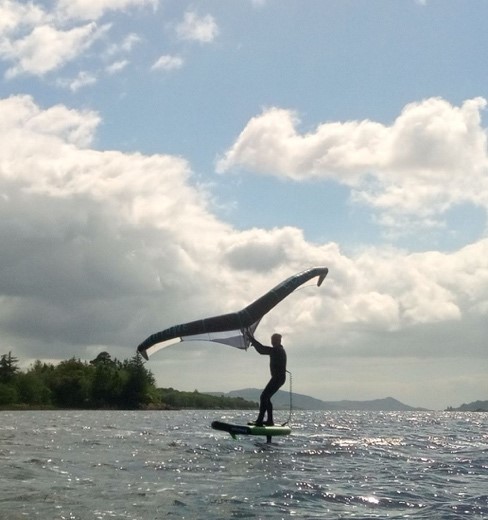
KayakMajik, based in Tarbert, is now offering lessons – give them a call to enquire about booking.
Community-owned Gigha is an enchanting small island and is easily explored by bike, by foot or from the sea by kayak.

Stand-up paddle boarding is the perfect water sport for all levels of ability and fitness. You can enjoy some sedate paddling in Argyll’s inland lochs and protected sea lochs

Argyll's beaches are brilliant locations for all sorts of watersports, from swimming to surfing. Get active on these Argyll beaches!